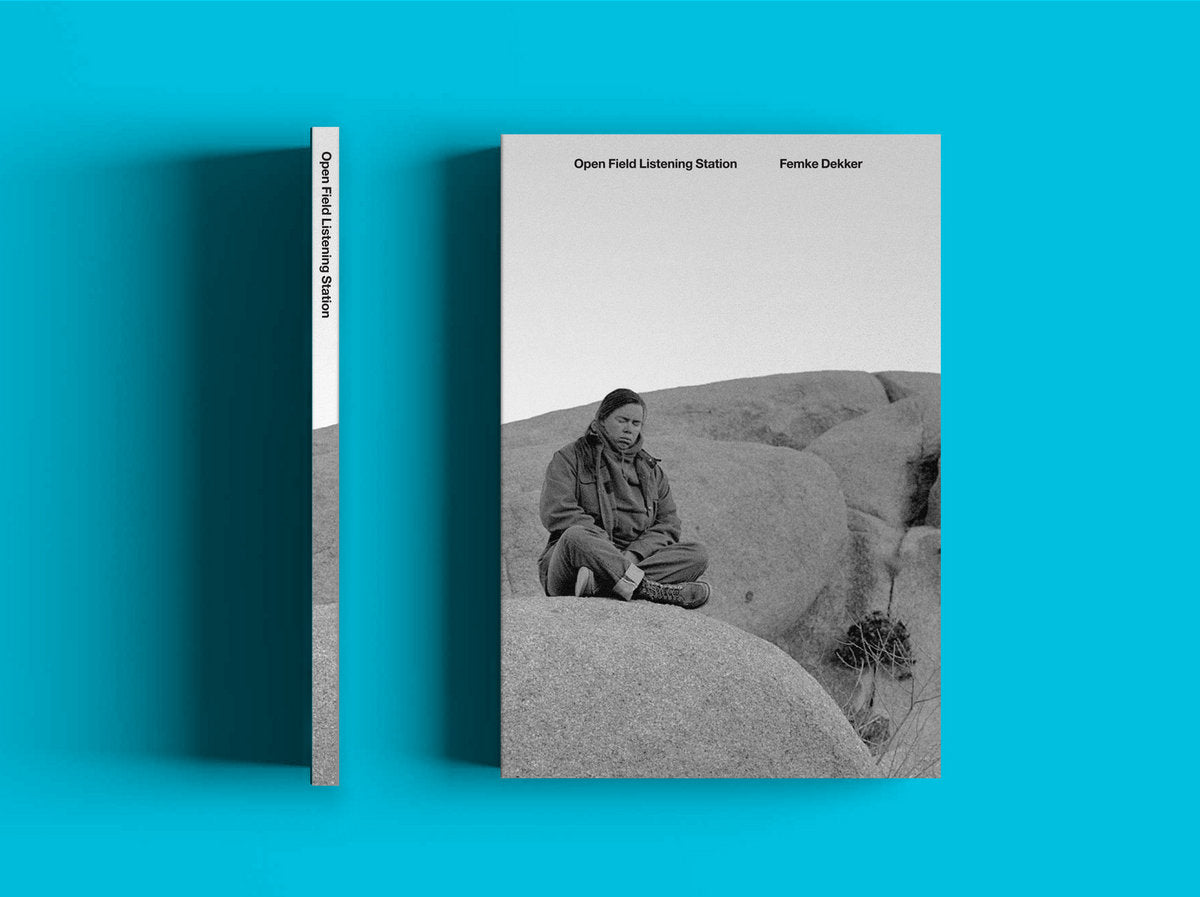
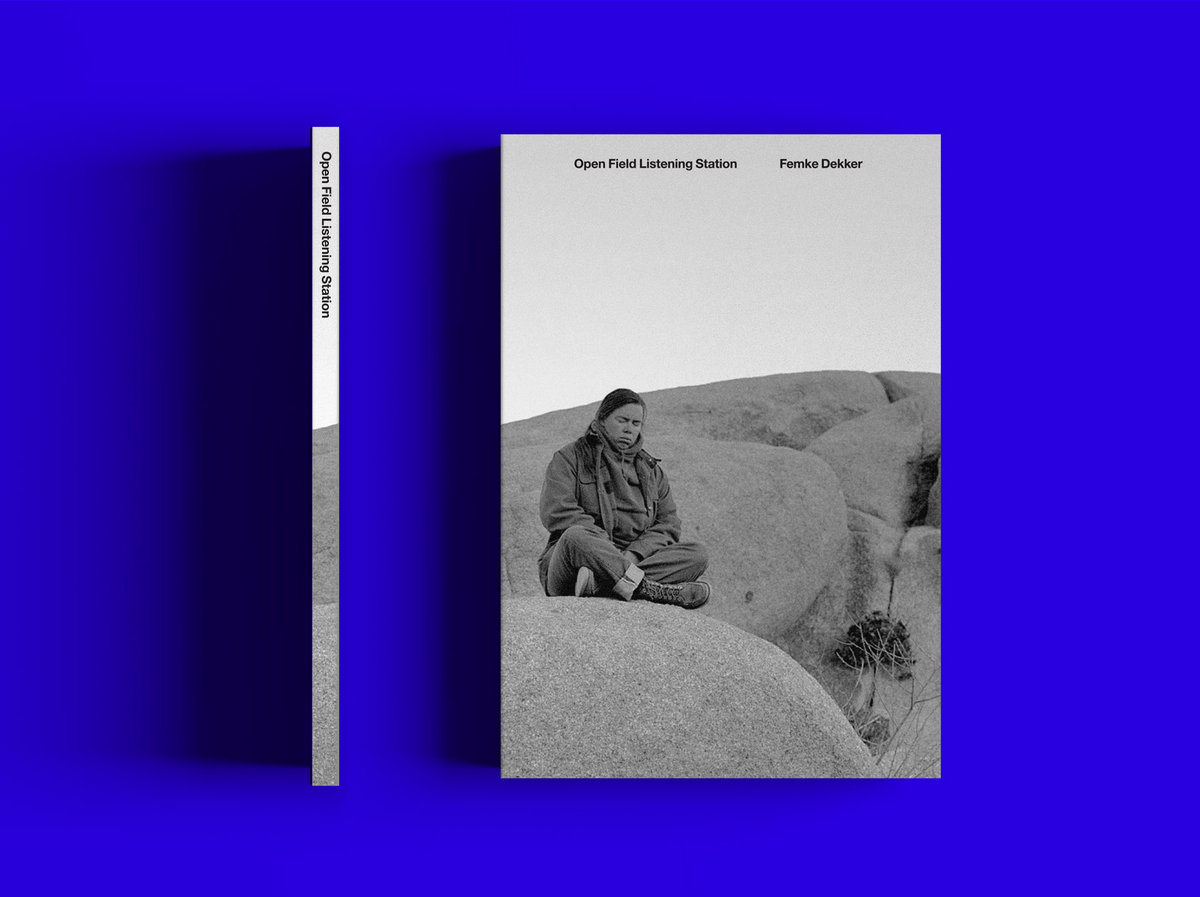
Femke Dekker - Open Field Listening Station
-
books
-
books

Practitioner, educator, DJ, and researcher, Femke Dekker (also known as Loma Doom) has long been immersed in both sound and education. Across lecture halls, archives, festivals, art galleries, independent radio stations, and dance floors, she orbits a central question: What if listening itself were an artistic practice? What might unfold when listening becomes method, medium, and material?
Open Field Listening takes shape around these ideas. Presented as a collaboration between Page Not Found—an artist-run platform dedicated to publishing and experimental practices—and the record label Osàre! Editions, the text originates from Dekker’s graduation thesis for the Master Education in Arts at the Piet Zwart Institute, Rotterdam. There, she honed her skills as a pedagogue, inviting students into improvisational jam sessions, radio-making, and exercises that activate new modes of attention and a heightened sense of sonic curiosity.

Drawing on the work of scholars and artists—most notably Pauline Oliveros—Dekker approaches listening as a call to action: a way of tuning into one’s surroundings, one’s body, and the urgencies that contour our political and social worlds. She emphasizes the radical potential of reorienting knowledge toward collective attunement: the we rather than the I (or the eye). Inspired by Oliveros’s concept of Deep Listening—a way of expanding awareness through focused, embodied perception—Dekker acknowledges the composer as a foundational feminist figure whose insights continue to reverberate through the classroom, the studio, and beyond.
Related Articles
-
Practitioner, educator, DJ, and researcher, Femke Dekker (also known as Loma Doom) has long been immersed in both sound and education. Across lecture halls, archives, festivals, art galleries, independent radio stations, and dance floors, she orbits a central question: What if listening itself were an artistic practice? What might unfold when listening becomes method, medium, and material?Open Field Listening takes shape around these ideas. Presented as a collaboration between Page Not Found—an artist-run platform dedicated to publishing and experimental practices—and the record label Osàre! Editions, the text originates from Dekker’s graduation thesis for the Master Education in Arts at the Piet Zwart Institute, Rotterdam. There, she honed her skills as a pedagogue, inviting students into improvisational jam sessions, radio-making, and exercises that activate new modes of attention and a heightened sense of sonic curiosity.Drawing on the work of scholars and artists—most notably Pauline Oliveros—Dekker approaches listening as a call to action: a way of tuning into one’s surroundings, one’s body, and the urgencies that contour our political and social worlds. She emphasizes the radical potential of reorienting knowledge toward collective attunement: the we rather than the I (or the eye). Inspired by Oliveros’s concept of Deep Listening—a way of expanding awareness through focused, embodied perception—Dekker acknowledges the composer as a foundational feminist figure whose insights continue to reverberate through the classroom, the studio, and beyond. -

Get Familiar: Lloyiso
Words by Passion DzengaWith the release of his debut album Never Thought I Could (Part 1), South African singer-songwriter Lloyiso is starting to tell his own story. Before sold-out European shows and collaborations with global artists, Lloyiso was teaching himself production in his mother’s house, busking to get by, and building his career from the ground up. That journey from independence to international recognition sits at the heart of Never Thought I Could (Part 1). Lloyiso touches on building his own team from scratch, the struggles behind releasing the album, and why independence gave him the confidence to trust his instincts. He also reflects on self-belief, burnout, and what it means to finally feel seen by audiences around the world.You’ve recently released Never Thought I Could (Part 1), how does this moment feel for you, and when you listen back to the album now, what emotions come up?Man, it feels like a weight has been lifted off my shoulders. I’ve been making this album for a couple of years now, and it’s been a tough time putting it out because some people don’t believe in it. There was a sound that was envisioned for me, but I created my own identity. This identity is truly who I am inside, and I’m just happy that I get to put it out into the world. It sounds like it was quite an uphill battle to get this record together. Why was now the right time to release your debut album?I had to build my own team. I had to build it from scratch. I had to find the people to stand up for what’s right, stand up for artist rights, stand up for real, authentic, raw talent, and not just follow the trends.I needed to find a group of people who are fearlessly unapologetic about expressing themselves in this music industry. So I started from the beginning. I found a label partner, EMPIRE. I put together my management team from all over the world. Everyone I work with is international, which was quite exciting, putting the team together that I have right now. We keep on growing and growing. The Lloyiso “empire”, if you get it, you get it. It’s expanding and becoming like a global partnership, a global-citizen type of thing. I needed to be comfortable in the team that I have to be able to put out this music.You’ve come from busking to self-producing, and now you’re working with major teams globally. Can you talk about that transition and what changed internally for you?It’s been a slow journey. Frustrating at times, because I always knew that I was destined to be on stage and hopefully not having to worry about carrying my own speakers, mixing my own voice, engineering, doing my own sound and managing myself.So I always knew that I needed to do that first before I could get into this place. And I’ve had to be tough. People speak about how dreams can make you harder than you want to be and I’ve had to be harder sometimes. As soft as I can be, I can also be a beast and those moments had to come out.I had to fight for myself. I had to feed myself. Moving out from home, living in a different city - I moved eight hours away from home to Johannesburg, and I basically paid for everything and lived by myself when I was 18 years old. So I’ve had to make those sacrifices of struggle to be able to tell the story. And I think it all comes together. The music is the story and it is the journey of what I was born to do. I had to go through that. I think if I had it easy, I would not have this much insight and depth and understanding of what it is to live for something.It feels like you prioritised independence before collaboration, can you tell us what did that independence give you that traditional systems don’t?It gave me confidence, man. It gave me the confidence that I don’t need anybody. I was doing numbers on YouTube before I got signed. I was basically Lloyiso before the other “L” was taken away. There was something that was trying to be taken away, but I never gave it. I never gave away that control. Never sold my soul. Now they talk about it in the music industry - “don’t sell your soul.” I haven’t sold my soul. I’m not going to sell my soul.I’ve had to be relentless in it. I’ve always fought for what I believe is right. Maybe it’s how I was raised, but being independent is something I’ve always done. I did everything by myself growing up. I walked to school, figured out transport and figured out how to get stationery or a uniform. I was always that kid who wanted better for myself. If I wanted to go to a new school, I’d find a way to get in so it’s always been in me to be independent.You taught yourself how to produce, what is it like being self-taught and what are the challenges that come with that?So I started producing on FL Studio. I played piano when I was like 12 years old, so that made it easier. I wanted a sound that was tailored to me. I felt like I was the only one who understood how my voice should sit in a song. I used to get frustrated going into the studio and producers would cancel on the day, in the morning. I was like, you know what - I’m tired of waiting for these guys. I’m tired of waiting for this moment. So I’m going to go get this moment.I took my mom’s old laptop, I figured it out, and I bought a mic. I plugged it into my old keyboard that I got when I was 12, and I started making music. It got better and better. Ever since then, I’ve been making my own music. That’s where it starts - at home. This album started at home, in my mom’s house, before it got out into the world, before LA. That production needed to happen for me to be fully comfortable in saying the things that I say and singing the way that I do.There’s a cinematic quality to your music. Can you talk about the sonic world you built on this album?It was definitely inspired by growing up listening to pop music – Sam Smith, Westlife, Jennifer Hudson, Beyoncé, Labrinth, Emily Sandé. I also drew inspiration from musicals like Camp Rock and High School Musical. I’m a ’99 baby, so I grew up on that. And gospel too. On this album, I put all of that together with a big inspiration - Kanye West. If you listen closely, you’ll hear it.When I started making the album, he had just put out his documentary, and I was like, you know what – I’m going to figure this out myself. I was inspired by that sound.What’s your process when starting a song? Is it melody, lyrics, or feeling first?It’s always a feeling. I let the feeling drive me. I don’t go into the studio unless I’m feeling really inspired or I have an idea. I’m a quality guy, not quantity. I don’t need to make a thousand songs to find the best one. The best ones come when you’re most inspired.And inspiration comes from life – being present, being outside, not always fixating on music. Watching sports, running when I can. It’s definitely from experiences.Is taking that space part of how you avoid burnout?Yeah, I could definitely be avoiding burnout without even knowing. Right now, I haven’t been in a making music space because I’ve got so much music waiting to come out. Part two is coming out! These songs have been sitting for two to three years, and I haven’t been in the studio since finishing them.Now I’m starting to think about what the next sound is going to be. I’m excited to explore, travel the world, and see where my voice sits best.Can you talk about your collaborations with artists like Martin Garrix and Clean Bandit?It started with me being inspired by their music. I messaged Martin Garrix back in 2016, saying I wanted to work with him. He didn’t see it at the time. Later, after my voice got shared around, he reached out and said he couldn’t believe he missed it. Same with Clean Bandit - I met them in South Africa, got into a writing room, started singing, and they went crazy.We were sending music back and forth across time zones, building the track in real time. It was meant to be. And I think my sound naturally fits within that time zone and space.Your European tour sold out. What was that experience like?Man, it was crazy. We sold out London, Amsterdam. Amsterdam was my favourite show. I didn’t expect people to come out like that. I thought I didn’t have a fanbase there. But it was incredible. I can’t wait to come back.You spent time running in Amsterdam with the community. What did that moment mean to you?It was incredible. I almost cried. To think about where I come from and what it took to get here, and to have a community that trusts me - it made me emotional. I felt seen. And that’s been a theme in my life - not always feeling appreciated or valued. So when that appreciation comes, it feels like finally someone gets it. It was beautiful to experience that.If you finish the sentence “I never thought I could…”, what would you say now?I never thought I could have more self-belief than I did before. I thought it was a phase, but I’ve been able to carry it through. I’ve been consistently appreciating myself and showing up for myself. I’ve realised I can do this. I’m capable of maintaining myself and being kind to myself.Do you still have fears?We’ll have to find out in part two. The story continues. It’s a rollercoaster. Part two will give more insight into what it feels like to be me - or what it might feel like for you too.Was this always planned as a two-part project?Yeah, it was always meant to be connected but not released at the same time. The title came later. After going through all the struggles and finally getting the green light to release the music, I realised - I never thought I could. I remember when I heard the news, I cried for like three days.Is faith important to you?I believe in the universe. I believe there’s something that connects us and gives purpose to everyone’s life.What advice would you give young creatives trying to stay consistent?For me, it was covers. But for someone else, it’s whatever your thing is. You can’t really put it into words. I wouldn’t want to tell someone how to be a superstar. Everyone becomes one in their own way. Trust your intuition. Your first idea is usually 95% right. The world speaks – you just need to listen.Listen to Lloyiso’s new album Never Thought I Could (Part 1) here.-
Get Familiar
-
-

Murkage Dave in-store performance at Patta Amsterdam
Murkage Dave in-store performance at ...
An in-store live performance, Q&A, album signing and community event featuring East London singer-songwriter and cultural custodian Murkage Dave. Following the release of his third album, Brut Thoughts which features collaborations with Cinnaman, Yard Act, Young Fathers and Lauren Auder. Dave also hosts The Outlet, his residency on Refuge Worldwide, where he shares a mix of influences alongside unreleased music from friends and collaborators. The event will highlight his introspective, genre-defying sound that blends pop, indie, and soulful storytelling. Expect an honest exploration of community, urban survival, and personal vulnerability. Free entry and first-come, first-served, so bring yourself and bring your crew. Dave began making music while studying in Manchester, releasing tracks including 'Hands On Her', which was remixed by Sunship and featured on a DJ EZ compilation. During this period, he also founded the influential weekly club night Monday Murkage, which evolved into Murkage Cartel. After returning to London in 2016, Dave formed HALFBROTHER with producer and singer SCALLY, before releasing his debut EP D.A.V.E. Its standout track, 'Car Bomb', received support from Pharrell Williams and Young Fathers. Around the same time, he partnered with Mike Skinner of The Streets to launch the club night TONGA.His acclaimed debut album, Murkage Dave Changed My Life, featured Manga Saint Hilare and Jaykae, with productions from Skepta and Star Slinger. The album earned praise for its vulnerability and distinctive sound, leading to shows with The Streets, Peace and Tricky. Following the Keep Up The Bad Work tour, Dave reunited with Manga Saint Hilare for the surprise collaborative project We Need To Look After Us. His second album, The City Needs A Hero, debuted at No. 10 on the UK iTunes Chart and earning further critical acclaim. The campaign was led by the double A-side single 'Please Don't Move To London It's A Trap' / 'Awful Things', featuring Caroline Polachek.-
Events
-
-

Patta Soundsystem at Homelanding
Homelanding’s second stage, Café Homeland, presents a five-day program featuring takeovers by well-known Amsterdam collectives. In this café, the collectives are given the freedom to curate and create an entirely unique program of their own.Get lost all evening among hip-hop DJs, punk bands, communal dinners, karaoke machines, and ping-pong tournaments. A true celebration of our city, its creators, and the diverse communities that shape us. On Sunday, July 5th, Patta Soundsystem will take over the evening program at Marineterrein, Amsterdam with free admission.-
Events
-
-

Oscar #Worldpeace - Chessboard Freestyle
Oscar #worldpeace returns with visuals for “Chessboard Freestyle” a sharp, cinematic cut from one of the UK’s most distinctive creative voices. A long-time collaborator of Mike Skinner, Ragz Originale and benji flow, Oscar brings the same raw intimacy and off-centre storytelling that’s made his visual language instantly recognisable across the underground and beyond.“Chessboard Freestyle” moves like a late-night thought spiral: calculated, restless and unpredictable. Every frame feels intentional; balancing tension, stillness and instinct with the precision of a player always thinking three moves ahead.-
Music
-
-

Get Familiar: Reuben Aziz
Words by Passion Dzenga | Photography by SPYDERAt a time when so much music feels engineered for algorithms, Reuben Aziz is building something far more difficult: a world people can emotionally live inside. Raised in Southampton, the 23-year-old artist has quietly built a world of his own — one shaped by emotional honesty, DIY creativity and a refusal to be boxed into genre. His latest mixtape mind the gap feels less like a sophomore mixtape and more like a statement of intent: a project that bridges vulnerability and ambition, faith and self-expression, melody and chaos. Having originally pursued basketball at a serious level before pivoting fully into music, Reuben approaches his artistry with the mindset of an athlete: disciplined, obsessive and constantly evolving. Over the past three years, he has steadily developed a sound that fuses pitched-up melodic vocals, hyperpop textures, alternative R&B and hard-hitting hip-hop production — often self-produced from his bedroom studio. Tracks like “shotgun,” which quickly gained traction online and earned co-signs from artists including Potter Payper and 4batz, have positioned him at the forefront of a new generation of UK artists creating emotionally raw music without sacrificing experimentation or edge. But beyond the viral moments and growing industry attention, mind the gap is rooted in something deeper. Throughout our conversation, Reuben speaks openly about masculinity, vulnerability, faith, purpose and the pressure of modern life. Where earlier music came from sadness and emotional confusion, this new chapter reflects a clearer sense of self — one grounded in his relationship with God and his desire to make music that genuinely uplifts people. Whether discussing the emotional complexity of modern relationships, building an intimate Discord community with fans, or touring Europe while still finding ways to stay spiritually grounded, Reuben carries himself with a level of self-awareness that feels increasingly rare in contemporary music culture.From my research, it seems like you were originally on a serious basketball journey before music became your focus. Looking back, what did that sport teach you that still applies to your music career?Discipline and consistency, for sure. The more I grow in music, the more I realise you have to treat it like a sport. Even though it’s creative, if you want longevity, you have to keep going no matter what’s happening around you. You have to keep creating, whether things are going well or not. Basketball taught me that mindset. It’s about constantly getting shots up, for lack of a better term.So when you talk about discipline, you mean talent alone isn’t enough — it’s really about putting the work in every day?Exactly. If you truly love something, you’re willing to work at it. Anyone who thinks talent alone is enough probably doesn’t love it deeply enough. Greatness comes from pushing yourself consistently. That doesn’t mean making ten songs every session, but it does mean trying to move the needle creatively every time. That’s what I tried to do with this project sonically.Let’s talk about the new project, Mind the Gap. What “gap” are you trying to bridge here?There are a few different gaps in my life that I’m trying to bridge — relationships, my relationship with God, my relationship with music and even my relationship with ambition. There’s also confidence in the title. I feel like I’ve reached a level where there’s a gap between certain people and me in the scene. This project is me showing that I’m ready to fully commit myself to this for the long run.The title also references the UK transport system, which makes it symbolic too. It feels like a journey — making sure you get off at the right stops in life.Exactly. Sonically, I wanted it to feel very London too. Even though people might label me as R&B, I wanted to break that genre barrier. A lot of the production was inspired by the UK underground scene and what’s happening culturally right now. I wanted to put my own stamp on it because I think what’s happening in the UK musically is really special.When I was describing your music to our music director, I genuinely struggled to define it. I called it something like “hyperpop, hyphy alt-rap, futuristic R&B.” It feels new.That’s important to me. If I hear a new artist and they just sound like someone I already know, I struggle to buy into it because I can just go listen to the original. If someone makes R&B that sounds exactly like early 2000s R&B, I’d rather just listen to Aaliyah or Boyz II Men. I want to make something people can’t get anywhere else.Your mixtape jumps across multiple sounds — R&B, hyperpop, and alternative music. Are you consciously trying to create something new?A bit of both. I’m chasing emotion, but production is what creates the atmosphere for those emotions to exist. When I’m thinking sonically, I’m not thinking about genres. I’m asking myself: “How can I make something that hasn’t been made before?” I started as a rapper, so even when I’m making these more melodic songs, the beats still come from a hip-hop mindset — the drums, the 808s, the energy. Everything else layered on top is just whatever the music needs. I genuinely think we don’t have enough artists trying to push R&B forward right now.Your music feels emotional, but also very controlled and intentional. What’s your creative process like? Is recording therapeutic for you?It’s definitely therapeutic. The first song I made for the project was actually the final track, “We’ll Get Married.” After that came “Shotgun,” and once I had those songs, I understood the world I wanted to build sonically. I’m intentional about the sound and direction of the project as a whole, but when it comes to writing, I try to be as emotionally vulnerable as possible. Especially as a man, I think there’s a lack of male singers speaking openly from that space. That’s something I really miss in music.“shotgun” has been everywhere lately. Can you talk about the songwriting process behind that record?It definitely gave me confidence and confirmed the direction I needed to take with this project. I made it at home — I produce everything in my room. I already knew what genres and influences I wanted to blend together for the track. Once I made the beat, I knew the lyrics had to hit emotionally. I went for a walk and wrote the opening lines there. I was being more intentional rather than just casually making another song.“shotgun” is a really beautiful love song — a modern take on romance. What inspired the lyrics?I think love today is complicated. My generation has a strange relationship with it — things can feel toxic and emotionally dishonest sometimes. Personally, I’ve always had a more wholesome or even “Disney” view of love. I think my music reflects me trying to navigate what that kind of love looks like in modern life.I think that honesty is exactly why your music resonates. A lot of people are scared to express what they truly want emotionally because nobody wants to look vulnerable anymore.Especially for men, there’s still stigma around vulnerability. It feels like people think you either have to be completely obsessed with someone or completely detached and reckless. But there’s a healthy middle ground between those extremes.A lot of young artists emotionally exhaust themselves chasing attention. How do you protect your peace while remaining vulnerable in your music?Religion is really important to me. Reading the Bible, going to church, speaking to my friends from church — all of that keeps me grounded. Social media makes comparison very easy, and that can distort how you see yourself. My relationship with God gives me humility and perspective. Without that, I’d probably be a lot more all over the place mentally.Has faith changed how you approach success and ambition?Definitely. There’s a song on the tape called “Ego Death,” and that’s a huge part of my journey. As I’ve grown closer to God, I’ve realised how much pride needs to die inside me. I’ve had to understand that this isn’t just about me. It’s about the music, about making people feel heard, feel joy, feel connection. Ironically, that mindset also pushes me to work even harder because I want the work to live up to that purpose.You’ve built a Discord community where you speak to fans daily. Was that an intentional move away from the superficiality of social media?Definitely. Discord has become a safe space — not just for me, but for the people in there too. Some of them have become real friends with each other. Social media can feel very surface-level. Discord creates intimacy around the music. I can play unreleased songs, get honest feedback and actually have conversations. I don’t even really think of them as “fans.” That word feels too distant. . Especially now, with AI and everything becoming more digital, people are craving physical experiences again — live shows, vinyl, CDs, real talent, real connection.You recently announced a train pop-up show. It’s such a DIY concept. What can people expect?We found this old underground train station-type location and we’re just going to perform there. I’ll bring my guitar, my friend’s DJing and we’ll play songs from the tape and older material too. I think the location helps build the world of Mind the Gap. I want everything around the project to feel intentional — not just the music itself. I don’t want to be lazy with any of this. I want people to feel like they’re stepping into a real world.You’ve also been touring around the UK and Europe with Artemas recently. What was that experience like?It was crazy. One of the most interesting things was performing for audiences who didn’t necessarily speak English, but still connected emotionally to the music. There were definitely moments where people didn’t know who I was yet, so I had to win them over. But songs like “Magic” always connected instantly.That tour taught me a lot about performing and about the importance of having a proper live setup. Artemas’ band was incredible and it made me realise how important a strong team is for building a show properly.There’s such a DIY spirit throughout your journey — bedroom production, self-built communities, self-produced records. Does that independence strengthen your creative identity?Definitely. For a long time, I thought working alone was the only way to create. But now that this tape is finished, I’ve realised I actually want to collaborate more moving forward. I needed these first two tapes to fully prove my own vision to myself and to the world. Now I feel ready to open things up and work with other producers and artists. I’m excited for what comes next.You recently spent time in New York and Atlanta too. What were you working on over there?We did On The Radar, which I’m excited about, and another live session called Red Couch with a full band setup. Because this project is so alternative and processed sonically, I also want people to hear the raw musicality behind it — the live instruments, my natural singing voice, all of that. Outside of that, we were mostly recording new music.Reuben Aziz's new mixtape "mind the gap" is out now!-
Get Familiar
-
-

Get Familiar: kruzer
Words by Passion Dzenga | Photography by Louis Oomes and Luca Wehneskruzer does not make music that feels accidental. Even when he describes his creative process as organic, there is a clear emotional world running through everything he creates: nostalgic synths inspired by childhood memories, cinematic songwriting rooted in real experiences, and huge melodic hooks designed to be screamed back in crowded venues. Born in Mogadishu and raised in the Netherlands, the Somali-Dutch artist has quietly become one of the most exciting new voices emerging from the Dutch alternative scene, building a sound that sits somewhere between hip-hop, pop, rock and emotional rap music without fully belonging to any of them.PhoHis latest project, VOORBIJ DE ZON (Beyond the Sun), feels like the clearest expression of that vision so far. Built alongside close collaborators and friends, the album blends raw vulnerability with widescreen ambition, pulling influence from Somali music, Kanye West, Kid Cudi, 80s synth music and films like Interstellar. But underneath the experimentation is something deeply personal. kruzer speaks about music less like entertainment and more like documentation — every song capturing a specific moment, relationship or emotional state in his life.You’ve been making music for quite a long time already, but this feels like the beginning of a new chapter creatively. Can you take us back to the start a little bit? What first made you want to become an artist?I started making music when I was around 17, around 2017. I’d always been curious about music and really fascinated by it. Then one of my friends started making music himself, so I asked him if he could teach me how to do it. At first, I was just downloading beats from YouTube, writing songs in my room and going to the engineers to record them. That was really the beginning. Eventually, I started meeting producers and building from there, but honestly, I still hadn’t found my sound yet.Around 2019, I started experimenting much more seriously and trying to figure out what I actually wanted my music to feel like emotionally. That was around the time I met a producer called Big Cam in Rotterdam, and through working with him, I really started shaping my sound. From the beginning, I always wanted to make what I call “stadium status music.” Music that feels emotional but also massive — the kind of music people can sing together live.That ambition is interesting because your music does feel very timeless and echoes the past through its references to 80s synth-heavy music, even when it’s vulnerable. Where does that sound come from?A lot of it comes from my upbringing. I was born in Mogadishu, Somalia, and when we lived in a refugee camp, my mom used to play a lot of Somali music, but also a lot of 80s music. That’s where my love for synths and nostalgic melodies really comes from. Then later, I became obsessed with Kanye West and Kid Cudi. Those are probably my biggest inspirations musically. Especially albums like 808s & Heartbreak and Man on the Moon: The End of Day. I love music that feels emotional and cinematic at the same time.The producer I worked with on VOORBIJ DE ZON, Strayed Saint, is also a huge Kanye fan, so we both wanted the album to feel nostalgic, emotional and immersive. I kept telling him, “This album needs to hit people in the heart.”The project definitely feels cinematic. If VOORBIJ DE ZON was a movie, what would it be?Interstellar. During the time we were making the album, I rewatched Interstellar again, and it really affected me emotionally. One of the hooks on the project was literally inspired by the movie. It’s my favourite film ever. The atmosphere, the emotion, the feeling of space and loneliness and hope — all of that influenced the music a lot.Did you know from the beginning that VOORBIJ DE ZON was going to become a full album?Not at all. It actually started as a small EP with maybe four songs. But we kept making more music and realised we had too much material we loved. At one point, Straight Saint literally looked at me and said, “Why aren’t we just making this an album?” So honestly, the album happened naturally. Every song was worked on heavily, too. Some tracks probably have fifty versions. We were really obsessed over details.And everybody involved in the project is somebody I’m genuinely close with in real life. Nothing was random. GRGY jumped onto one of the songs naturally during the process and made it way better. Vjeze Fur also happened almost accidentally. Everything about the album came together organically.That word keeps coming up when you speak, "organic".Because that’s genuinely how everything in my career has happened. Nothing was forced. Even the relationships I built around music happened naturally.You’ve mentioned before that Ray Fuego played an important role in your development creatively.Definitely. Around the time I was still figuring out my sound, Ray really took me under his wing creatively for a couple of years. He gave me advice, helped me think differently and pushed me creatively. I’m super grateful to him for that.A lot of my connection with the wider SMIB world also happened naturally because my best friend, Bokoedro, already knew people from there. I started going to shows and parties with him, and eventually we all became friends naturally.You also worked with BNYX pretty early on, before he became the huge producer he is now.Yeah, this was around 2019. I was in the studio with a producer friend who had some loops from BNYX. I heard one and immediately asked, “Who made this sample? This is crazy.” Then I checked his work and saw he’d already worked with people like Lancey Foux and Ty Dolla $ign. So I just DM’d him directly and told him I had a song using one of his loops. He replied within fifteen minutes and from there we just stayed connected. We still talk now.Your previous project Elke Koning Heeft Pijn (Every King Has Pain) felt much darker emotionally. Looking back now, what does that project represent to you?That project means a lot to me because at that time, I didn’t really have the resources or people around me that I have now. I didn’t have proper engineers or proper setups. Everything was raw. I was also really depressed during that period in my life.The title came from this idea that everybody is hurting in some way underneath the surface. People only see the bigger picture or the outside image, but they never really know what someone is carrying internally. So for me, the project was about understanding that pain exists in everybody’s life and that you can’t judge people based only on appearances.Your music feels very autobiographical too. Almost like every song documents a specific memory or emotional state.Because every song really is based on real life. My music is basically my diary. Even my biggest song, “Me hart is op,” is literally about my love life. Every track captures a specific moment in my life, so when I listen back to older songs, it feels like revisiting old chapters of myself.There still aren’t many Somali artists visible in alternative music spaces like this. What has that experience been like for you?At first, it felt strange because I wondered if I was the only Somali-Dutch artist making this kind of music. But eventually, I made peace with it. Now I actually hope I can become an example for younger Somali kids so they feel freer creatively. I think it’s important to represent where you come from and not hide it.I heard you sampled one of your mother’s favourite song on your EP Rezurk as well.Yeah. I always wanted to sample that song. The lyrics are very poetic in Somali so it’s difficult to translate properly, but it’s basically about a boy chasing his vision. When I told my mom I used it in the album, she was really happy because she felt like I was honouring my roots.Is there anything creative you still want to explore further?I’m already working on the next album, actually. This next project is going to be way more festival-focused. I want to make music that people can scream together live. I also want to lean further into rock & synth pop influences. Artists like David Bowie and Pet Shop Boys inspire me creatively a lot.You’ve already received support from artists like Ronnie Flex, Ray Fuego and Vjeze Fur pretty early in your journey. What do those co-signs mean to you?It reassures me that I’m on the right path. All those artists make completely different kinds of music, so the fact they all connect with what I’m doing makes me feel like maybe I’m creating something unique. What becomes clear when speaking to kruzer is that his music is less about genre and more about feeling. Every project feels carefully constructed emotionally, even when he insists much of it happened accidentally. Beneath the synth-heavy production, huge hooks and alternative textures is someone trying to document his life honestly while building something larger than himself at the same time. And maybe that is what makes VOORBIJ DE ZON resonate so strongly. It does not sound like an artist chasing trends or trying to fit neatly into a scene. Not because it tries to sound like the future, but because it sounds like someone becoming fully comfortable with who they already are.-
Get Familiar
-
-

Living Proof - London Issue
This issue highlights Wiley, Universally hailed as “the Godfather of Grime”, the London-born MC and producer Wiley has played a massively influential role in bringing the UK Grime movement to a worldwide stage throughout his prolific and storied career marked by the extreme highs and lows of violence, controversy, and global stardom.Emerging from London’s culture of pirate radio stations and garage music during the early 2000’s, Wiley followed in the footsteps of his father - a reggae musician who introduced him to hip-hop at a young age - and began producing instrumentals mixing the regional influences of dancehall and jungle music, adding verses to his tracks with a wide variety of collaborators including members of his original grime crew Roll Deep, formed in 2001.As grime became a global phenomenon during the 2010’s, Wiley remained at the forefront of the genre, pushing the movement forward through his innovative work ethic and a consistent ethos of collaboration. Today, his enduring legacy is present within the sound he helped pioneer, becoming a foundational influence on a new generation of stars across the scope of UK rap and drill music.This issue also highlights M Huncho, Bel Cobain, AJ Tracey, TOX DDS, Amy Leung, Dynamite, Victory Lap Radio, D Double E, Potter Payper, Charlie Birch, Karim B, E Pellici, Tim & Barry. Living Proof, the London Issue is available now at Patta London.-
books
-
-

Jyoty - The Listening Room
Born in Amsterdam to Indian parents and raised between Bollywood soundtracks, Qawwali, Dutch hip-hop and the soundsystem culture of her Moroccan and Turkish neighbourhood, Jyoty’s relationship with music has always been shaped by movement between worlds. In this episode of The Listening Room, the DJ and broadcaster traces the moments that formed her musically — from hearing Nusrat Fateh Ali Khan in her mother’s living room and Bhangra at family weddings, to discovering Dutch rap, electronic music and eventually finding herself inside the sweaty basement of Dance Tunnel, the legendary Amsterdam club that helped shape her understanding of dance music culture. -

A1 Denim Polo Tour at Patta Amsterdam
The A1 Denim Polo Tour continues with Stop 2 landing in Amsterdam this Saturday, 23/05/26 from 11AM. Join us at Patta Amsterdam for a day celebrating classic sportswear, community, and mainline essentials. We’ll be giving away free Polos on a first come, first served basis while stocks last, so make sure to arrive early. Alongside the giveaway, a selection of Mainline A1 Denim will be available to purchase in-store throughout the day.-
Events
-