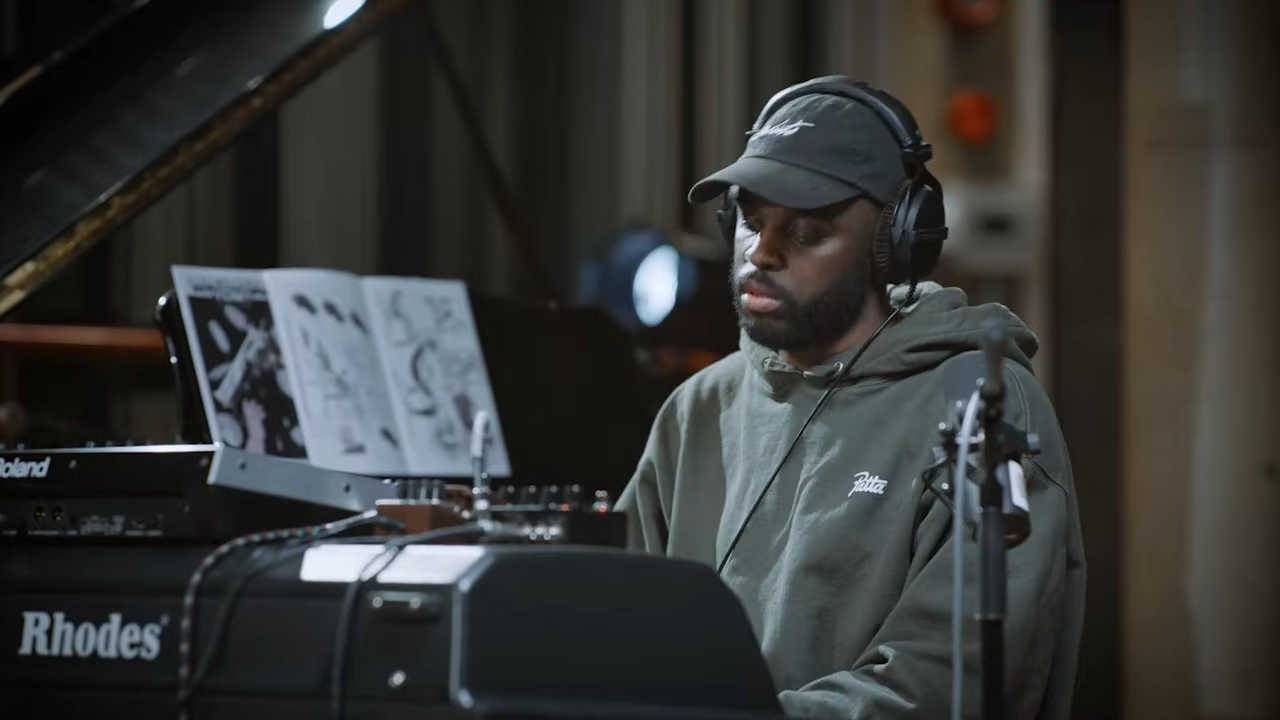
Alfa Mist - Live at Real World Studios
-
Music
-
Music

On Roulette, his sixth studio release, the prolific producer, songwriter, pianist and MC Alfa Mist created a vivid sci-fi universe — a vast dystopia shaped by themes of revenge, forgiveness and redemption. Now, that world is brought into sharp focus in a new video capturing Alfa Mist performing tracks from the record live at Real World Studios.
Filmed in the renowned Wiltshire studio complex, the performance strips Roulette back to its emotional core while amplifying its conceptual weight. Alfa Mist’s music has always grappled with big ideas, but here those ideas feel immediate and embodied. Roulette imagines a near-future where reincarnation is discovered to be real — a force connecting dreams, past lives and accumulated knowledge — raising urgent ethical, moral and philosophical questions. In this live setting, those questions resonate with renewed intensity.
Across the performance, Alfa moves through selections from the album as if spinning the wheel once more: each track revealing a different character, mood and perspective. His unmistakable signature remains — lambent piano lines, intuitive grooves and moments of free-flowing jazz improvisation — but in the acoustics of Real World Studios, the music takes on a deeper, more cinematic presence. The smoky psychedelia of Roulette feels immersive and tactile, designed not just to be heard but fully felt.
The video also highlights some of Alfa Mist’s most ambitious arrangements to date, including passages that glide effortlessly through shifting time signatures. “Life’s not always linear,” he has said — a philosophy that plays out vividly in the fluidity of the live performance.
This Real World Studios session underlines Alfa Mist’s position as one of the most forward-thinking composers in UK music today. With melodies that linger long after the final note, the performance captures an artist in constant evolution. As Alfa puts it: “Music is a constant; it’s my state of mind that I keep chiselling and working on.” In this filmed performance, that process is visible, audible and deeply compelling.
He performs in Amsterdam at Paradiso on Wednesday, January 28th. Tickets are available now.
Related Articles
-
We’re excited to invite you to our Amsterdam book signing for Nifemi Marcus-Bello’s ‘Oriki: Material Affirmations in Three Acts’, on Saturday, January 24, at the Athenaeum, with support from Patta and Apartmento. The evening will also feature a live conversation with the artist, moderated by Claudio Ritfeld. Friends in Amsterdam, come listen in, from 5–7pm, meet the artist, and get your copy signed! We can’t wait to see you all there. -

Alfa Mist - Live at Real World Studios
On Roulette, his sixth studio release, the prolific producer, songwriter, pianist and MC Alfa Mist created a vivid sci-fi universe — a vast dystopia shaped by themes of revenge, forgiveness and redemption. Now, that world is brought into sharp focus in a new video capturing Alfa Mist performing tracks from the record live at Real World Studios.Filmed in the renowned Wiltshire studio complex, the performance strips Roulette back to its emotional core while amplifying its conceptual weight. Alfa Mist’s music has always grappled with big ideas, but here those ideas feel immediate and embodied. Roulette imagines a near-future where reincarnation is discovered to be real — a force connecting dreams, past lives and accumulated knowledge — raising urgent ethical, moral and philosophical questions. In this live setting, those questions resonate with renewed intensity.Across the performance, Alfa moves through selections from the album as if spinning the wheel once more: each track revealing a different character, mood and perspective. His unmistakable signature remains — lambent piano lines, intuitive grooves and moments of free-flowing jazz improvisation — but in the acoustics of Real World Studios, the music takes on a deeper, more cinematic presence. The smoky psychedelia of Roulette feels immersive and tactile, designed not just to be heard but fully felt.The video also highlights some of Alfa Mist’s most ambitious arrangements to date, including passages that glide effortlessly through shifting time signatures. “Life’s not always linear,” he has said — a philosophy that plays out vividly in the fluidity of the live performance.This Real World Studios session underlines Alfa Mist’s position as one of the most forward-thinking composers in UK music today. With melodies that linger long after the final note, the performance captures an artist in constant evolution. As Alfa puts it: “Music is a constant; it’s my state of mind that I keep chiselling and working on.” In this filmed performance, that process is visible, audible and deeply compelling.He performs in Amsterdam at Paradiso on Wednesday, January 28th. Tickets are available now.-
Music
-
-

Get Familiar: $ouley
Photography by Antoine | Interview by Passion DzengaComing out of Bordeaux rather than Paris has shaped $ouley’s music in subtle but important ways. Growing up in a second city, far from the expectations and infrastructure of the capital, he learned early to trust his own instincts and build without permission. Skate spots, bedrooms, video games, and the internet became his classrooms, allowing a sound to form that feels unforced and unconcerned with tradition for tradition’s sake.$ouley’s music draws from a wide emotional and cultural archive—hip-hop and French rap sit alongside Senegalese influences, soul records, video game soundtracks, and the quiet intensity of films like The Wire. Instead of leaning into boom bap or chasing familiar formulas, he moves toward something looser and more future-facing, where feeling leads and genre lines blur.What emerges is an artist driven by intuition and connection: beats that “speak,” visuals shaped through friendship, and live shows that prioritise presence over polish. In this conversation, $ouley reflects on finding his voice outside the spotlight and staying grounded while his world continues to expand.You’re based in Paris now, but you’re originally from Bordeaux. What did it mean to come up in a second city—somewhere that isn’t the capital?Bordeaux is special, but it’s not Paris. It’s not a place where you feel like the industry is waiting for you. If you want to make art there, you have to be strong enough to accept your creativity by yourself first—nobody is going to bring it to you. I grew up in the hood in Bordeaux, and for a long time I was hiding the fact that I even made music.When you say “hiding,” what do you mean?I wasn’t telling people like that. I had my brothers, and they were doing their own thing, and I felt like I had to create my own world. There wasn’t this big city feeling where you can just go somewhere and find a scene instantly. So I kept it private until it started to become real.What was the moment where it started to become real?When I realised people outside my circle were listening. Someone would tell me, “Older people in the city know your name,” or “Somebody’s little brother is a fan.” Then I got invited to perform, and I didn’t even believe it—because I was still figuring myself out. But once you see people really show up, you understand it’s bigger than your bedroom or your phone.With regards to your early influences: family, video games, and building a personal library. What kind of music were you raised on?In the house, it was hip-hop, French rap, US music, and also music from Senegal and Guinea-Bissau like Americo Gomes, because my family is Senegalese. My brothers showed me a lot. My sister too—different things. And I was curious, so I absorbed everything.You also mentioned video games being important.Huge. Video game music helped me build my own library. It’s not just what your family plays—games give you sounds you wouldn’t hear anywhere else. Midnight Club, Gran Turismo, Rockstar games… those soundtracks stayed in my head.Were films part of that education too?Yeah. Old gangster movies, French movies, Disney Channel, The warriors and shows like The Wire. That’s how I discovered Nina Simone. It was like mature music, grown-up music, and it expanded my taste early.From private worlds to publishing music, how did you actually start recording?Skateboarding was a big part of it. I was into Tyler, The Creator and Odd Future, that internet energy. I saw him making music on a MacBook and it made it feel possible. So me and my friends would go downtown and I’d record ideas wherever I could—sometimes even in places like the Apple Store. Before that, I’d already be writing my words down before i even thought about putting it on beats.And then you just started uploading?Exactly. I didn’t overthink it. I uploaded and slowly a small community formed around it. I started on SoundCloud When did you start feeling like you had something to say?It started with writing. I was in private school, but I’m from the hood, so I was seeing different worlds at the same time. I was hearing too much, seeing too much, and it made me want to speak. I did poetry first. Then I started reading my poetry over instrumentals. That’s when I realised I had something—like I wasn’t alone.When did you find your real creative circle?When I met people who had a similar musical education—people who didn’t judge you for doing something new. That’s when studios and sessions started happening more naturally.What’s your writing process now—words first or beat first?Beat first most of the time. Every beat makes me write differently. Sometimes life gives me words first—I write something down, then later a beat matches it. But usually the music speaks to me, and I follow it.Who are the key people around you musically?MH is important—he’s in Paris now but we’re both from Bordeaux. CTP, Deejay Sammy, Gustavio Topman and Yuri Online. We talk music all the time. Then there are people outside France too. I like working across scenes and countries.Do you mess with TTC?Yeah, TTC are legends. They were early with different instrumentals and voice effects in France.Your music is very future-facing. Why did you go that direction instead of classic boom bap?I like new sounds. Artists like Lil B, SGP, Tyler the Creator and the whole internet era showed me you can create a new sound and still be yourself. Hip-hop can have rules—like you have to look a certain way, sound a certain way. Electronic music is more about feeling. I wanted to sound like me. Not like an American version of someone else.What was your first live show like?I was stressed. I couldn’t believe people would pay to see me perform songs I made in such a DIY way. I thought it would be a small crowd, then it was packed. I was nervous and a little too aggressive at first—my friends had to tell me to relax. But now I enjoy it. Now it’s fun.Do you have any pre-show rituals?I check the sound, drink water, listen to my beats. I’m grateful. I close my eyes and just focus.What feels like the next step for you?Travel more, shoot more videos, collaborate more. I have listeners all over the world and I want to meet people in real life, bring the music outside France, and not be afraid of new places.Any dream collaborations?Babyfather would be crazy. And I’d love to do more with people I respect, but timing matters. I want to build real connections, not just chase names.What’s the song that always gets a reaction live?“SUPERFLY (Criminel).” Every time that beat drops, people scream.Why does it have two names?Because in the lyrics I say the way she looks at me is criminal—like she’s sniping me with her eyes. But “Superfly” is the feeling: I’m fly, it’s cinematic, it connects to that movie energy.What’s a more personal record for you?Fever FM is very personal. Songs like “Memory Terio.” And “Party!” too— with the Gran Turismo 4 OST sample. It’s fun but it’s also my real world. Fans told me they played the same game, so it connected deeper than I expected.Your visuals are strong. How do you build that world—covers, videos, the whole language?I have ideas, but it’s also community. I work with friends like Antoine and with people around me. For covers like the Summer Tape artwork, I worked with Julien Marmar—he’s a real artist. For videos, sometimes it’s simple: we see a location, we go, we shoot. We don’t overthink it. When it’s real, people feel it.Can we expect another Summer Tape soon?Maybe later. Right now I want to do something new.Where can people support you?Most of it is on streaming. But I like experimenting with physical drops too—keeping some songs off streaming so the people who really care can find them in a different way.-
Get Familiar
-
-

Get Familiar: Nederland Wordt Beter
Photography by Karim Sahmi, Zazilie Currie, Dag van Empathie, Luciano de Boterman, Nederland Wordt Beter, New Urban Collective, Mitchell Esajas, Hollandse Hoogte and Raymond van Mil | Graphic by Chayenne van den BrinkIn activism, endings are rare. Movements are often defined by their refusal to stop, by an open-ended urgency that resists closure. To declare an endpoint — to say the work we set out to do is complete — is, in itself, a radical act. That is precisely what Nederland Wordt Beter has chosen to do. From 2010 to 2025, NLWB positioned itself not as a permanent institution, but as a deliberate intervention: a 15-year confrontation with anti-Black racism in the Netherlands, designed with a beginning, a strategy, and a clearly articulated end. On 5 December 2025 — a date long symbolic of exclusion and harm — the movement dissolved itself. Not because racism has ended, but because the goals it set out to achieve have been met. Those goals were neither abstract nor rhetorical. They were concrete, structural, and measurable: the embedding of colonial and slavery history in education; the transformation of the Sinterklaas tradition into an inclusive celebration free from racist stereotypes; and the legal anchoring of the national commemoration of the abolition of Dutch slavery.To understand the significance of this moment, one must understand the discipline behind it. As Jerry Afriyie — poet, organiser, and co-founder of NLWB — explains, the decision to limit the movement to fifteen years was not a concession, but a strategy. Activism without an endpoint risks burnout, dilution, and institutional stagnation. Activism with an endpoint demands clarity: what exactly are we trying to change, and how will we know when we have succeeded? Over fifteen years, NLWB delivered more than 500 lectures across schools, universities, companies, and government institutions. It produced open-access educational materials, teacher guides, activist handbooks, and a historical calendar documenting nearly 200 moments and figures erased from dominant Dutch narratives. It initiated campaigns that reshaped public discourse — from Zwarte Piet Is Racism to #1julivrij — and helped organise the largest anti-racism protests in Dutch history following the murder of George Floyd in 2020. But the most visible impact unfolded in everyday life.Fifteen years ago, Keti Koti — the commemoration of the abolition of slavery — was unknown to most Dutch students. Today, it is nationally broadcast, structurally funded, and legally anchored, with an annual budget of €8 million supporting commemorations across both the European Netherlands and the Caribbean. Slavery history is now mandated in secondary education. Municipalities, museums, and ministries have revised policies, curricula, and public narratives. Apologies once considered unthinkable have been issued by both government and monarchy. Perhaps most symbolically, a tradition long defended as “innocent” has been transformed. Where Blackface once dominated public space each winter, two-thirds of the Dutch population now support moving away from the tradition of Zwarte Piet. Nearly all municipalities no longer subsidise parades featuring racist imagery. What was once normalised has been historicized — relocated, finally, to the past.This transformation did not come easily. The work demanded confrontation, persistence, and personal sacrifice. Afriyie speaks openly about the cost: years of public hostility, professional consequences, physical danger, and time lost with family. NLWB endured surveillance, mischaracterisation, and, at one point, inclusion in a national terrorism assessment — later formally corrected. These were not symbolic battles. They were lived realities. And yet, NLWB refused both martyrdom and vengeance. The movement’s philosophy was pragmatic, not punitive. Justice, not revenge. Structural change, not spectacle. Protest was a means — never the goal. Dialogue mattered, but so did boundaries. Allyship was welcomed, but Black leadership remained non-negotiable. The movement understood that visibility without control risks reproducing the very hierarchies it seeks to dismantle. This is why the decision to dissolve now carries such weight.NLWB does not disappear into silence. Its legacy is deliberately archived — preserved through partnerships with The Black Archives, the Amsterdam City Archives, and public platforms that ensure future access to its materials. Its final exhibition, Netherlands, Do Better! – The Impact of 15 Years of Black Activism, offers not a victory lap, but an invitation: to study what worked, to learn what it cost, and to ask what comes next. The travelling exhibition extends that question across the country, province by province. The theatrical tribute, The Final Word, honours not only visible leaders but the quiet labour of communities who sustained the work. Now, the movement ends not in mourning, but in celebration — a deliberate refusal to let struggle erase joy.In passing the baton, NLWB insists on a final truth: progress is not permanent. It must be protected, renewed, and expanded by those who inherit it. The work does not end because racism has vanished; it ends because responsibility has shifted. As Afriyie reminds us, a country can only do better if its people do better — not just for themselves, but for each other. The measure of this movement is not only what it changed, but what it makes possible. The Netherlands is not finished becoming better. But it is no longer allowed to say it did not know.Who are you — and what are you about?I’m a poet, but for a long time I haven’t been able to fully live inside that identity — because the work of movement-building demanded something else from me. I was originally born in Ghana, raised largely in the Netherlands, and I’ve been here for almost 35 years. I’ve lived my adult life in this country. I know this country deeply — in many ways I know it more than Ghana, because this is where my children were born and raised, and where my community has had to fight for dignity in public, year after year.You said you’re a poet, but you’ve also been “occupied” by movement work for nearly two decades. How did that shift happen?From the age of 18, I started organising through an organisation I called So Rebel Movement. That was my starting point — and it was rooted in a very clear mentality: “for us, by us.” A Black-led, Black-guided movement that doesn’t ask permission to exist, and doesn’t need validation from outside the community. But the past 15 years became something else — a kind of intervention. The conditions became so urgent, and the pressure so constant, that I had to stop certain parts of my own life and “finish this job.” In many ways, I’m now returning to what I was always meant to be doing — but with lessons learned and scars that prove the cost of this work.Independence keeps coming up in your answers. What does independence mean to you in a Dutch context?My vision — whatever I do next — is to ensure I don’t need anything from the white community to make it happen. I’m very serious about that. For years, the work was focused outward: we were showing white Dutch society racism, discrimination, and the unfair treatment of Black people. That wasn’t because we wanted our lives to revolve around white people’s awareness — it was because the noise from that side was so loud that it blocked everything else. It was interfering with our ability to concentrate on what we wanted for ourselves.Now I feel like we have shut that noise down enough to get back to work. Because beyond the obstacles — yes, we know the obstacles — the most important question becomes: how do we overcome them by our own strength and our own means? I believe we already have everything we need to lift ourselves up. Sometimes we spend too much time seeking help where we don’t need help.Your movement is now dissolving. People might read that as “giving up.” How do you frame it?I frame it like work. If you’re working on a project and the project is finished, it’s finished. That doesn’t mean the whole world is suddenly perfect. It means you achieved the thing you set out to achieve — something big enough to matter, but not so abstract that it becomes a never-ending mission. We chose goals that were structural and measurable, so you could actually say: we did this. And now we can sign it off.So what were the goals — specifically — and why those?We had three goals. The first was structural education: colonial and slavery history in the curriculum. Before our movement, those were not meaningfully embedded the way they are now. Today, they are added.The second was education about racism itself — teaching about racism in schools. This was something we achieved together with another organisation, including a younger organisation that formed after the BLM demonstrations we organised here. It matters to me that younger people picked up momentum and built institutions of their own — because that’s also part of movement success: you don’t just win something, you create conditions for others to organise.The third was national commemoration. Fifteen years ago, many people didn’t know Keti Koti. Government funding had been cut down heavily — reduced to around 100,000 euros a year. Now it’s moving to 8 million euros per year going forward. And importantly: it’s not only to facilitate commemoration in the Netherlands. It also includes the Dutch Caribbean and Suriname — because our position was always: if something is gained here, those places must receive a fair share too. This is long overdue. And now the commemoration is nationally broadcast on TV and radio.When you say “it’s measurable,” what does it look like in real life?I’ll give you a simple example. Fifteen years ago, I would stand in front of classrooms and ask students: “Who has heard of Keti Koti?” Only a few hands would go up. Ask that question today — and all the hands go up. That’s a shift you can feel. It means the country cannot pretend anymore that it doesn’t know. Compare 2010 to 2025 and you can see the difference — not just in policy, but in public awareness. It’s visible.You also talk about the “noise” being shut down. Do you mean denial?Yes. Denial, dismissal, pretending it’s harmless, pretending it’s not racist — all the excuses. Our work forced the country to confront what it was doing. And once that confrontation happens at scale, it becomes harder to push the conversation back into silence.The Dutch king has apologised in multiple places and there’s research being done into royal involvement in slavery. How do you interpret that?It shows the scale of the shift. There are cities conducting research into their own involvement, writing reports, uncovering records. Because the truth is: the whole country profited from that history — or at least was complicit in it.These investigations matter because before, it took enormous energy from Black people just to start the conversation. When history is hidden, every conversation becomes a battle over “did it happen?” and “does it matter?” Bringing it to the surface opens the door to honest conversation beyond that.You said earlier: “removing ourselves is making space for the country.” Why step back now? Why not stay and keep pushing?Because part of movement maturity is knowing when your presence becomes the reason the conversation doesn’t evolve. If your movement is always the engine, the country can always blame you for “making a fuss.” But once those doors are open, and once the goals are achieved, stepping away forces the country to carry responsibility.Also, there’s the next generation. Our children — who are now adults — come with a different energy. They’ve seen that you can make a difference. They can choose what difference they want to make.Was there a moment where you had to decide what kind of movement you were building — reformist, revolutionary, something else?Yes, and it was painful. I had to ask myself: Do I want justice or do I want revenge? Because if I let anger lead me, my sight becomes blurry and my thinking becomes blurry. That caused heated discussions with people around me. Some people left because the backlash was too harsh, because they couldn’t handle the violence, because they had jobs and children and couldn’t risk it. Some people thought I was too soft. Others thought I was too radical.But I was always planning based on reality: how many people do we have, how far are they willing to go, what means do we have, what can we sustain? If we had declared “revolution” instead of fighting for pragmatic structural wins, it would have cost even more — and we might not have survived.What did you refuse to compromise on?Anything that kept even “a little Blackface.” Not acceptable. There were places that removed the entire figure. Others tried to keep things “close” to the racist element by using variations like “chimney” versions — anything that allowed them to stay emotionally attached to the caricature.But our view was: the solution is to move as far away from it as possible, so it’s not recognisable — because the harm is in the association. Children will make the comparison. They will confuse Black people for the caricature. That isn’t the child’s fault — it’s because society created a caricature and planted it everywhere.You keep returning to children. Why is that the centre?Because the tradition isn’t private — it’s national. It’s in schools, malls, streets, television, public space. People used to tell me stories of elders in their 60s, 70s, 80s who would avoid going outside during that period decades ago — only going out for work or groceries and then locking themselves in. Because the streets were full of people mimicking them, laughing at them, turning them into a public joke. That trauma sits in bodies for a lifetime.A lot of people remember the first time they realised they were Black. You don’t realise you are “other” until somebody others you. And being mocked publicly by both parents and children is one of the cruelest ways to learn that difference.What tactics actually worked over 15 years — if you had to explain your “method”?The biggest key is the first step: you take it, and you don’t stop. You keep going. But also: we diversified. Protest alone won’t get you there. Protest is a means, not the goal. We protested, created educational tools, built coalitions, had dialogues — even with people who attacked me. We didn’t start by begging politicians and media to take us seriously. We went to people in the streets first. The media found us before we even wrote a press release, because we were present — we were talking, confronting, insisting on the conversation where people were.I’ve spoken with thousands of people one-on-one over 15 years — almost every week, sometimes nearly every day. If you want real change, you have to be willing to do the unglamorous work.You also talk about allyship. How did you build coalitions without losing Black leadership?This is crucial: the movement began with around 90% Black people. Over time, more white people joined, and many Black people left — largely because the violence targeted Black participants most directly. So I made sure: even if I was the only Black person in the room, the movement stayed Black-led and Black-fronted. This country listens more easily to white people. But I refused to let white people become the face — because Black children needed to see Black people leading and holding ground.The allies who stayed understood that. They questioned me sometimes, but they gave me space to lead. And in return, it taught me something too: seeing white people committed to our success made me more committed to other struggles. That’s how solidarity should work.You mentioned a “price.” What did that price look like in reality?It cost a lot. People burned out. People lost jobs — including me. People were threatened. People were attacked. We were called terrorists. We were placed in a national terrorism report. There were years I wore a bulletproof vest.My life was on hold for 15 years. My daughter is 15 — born the same year the movement started. My son is 22 — he was around five or six when it started. I have never been on vacation with them. They went with their mother, but not with me. There were many nights I couldn’t be present the way a father should. That’s not something I say proudly — it’s something I say honestly, because people need to understand what “change” actually costs.But I also knew: the alternative is worse. How can I accept living in a country where, for two months every year, anti-Black racism is everywhere — on television, in streets, in schools, in malls — and people are having the best time of their life at our expense?How did you keep people safe in the face of intimidation and violence?My mindset was: we are fighting a war, and you have to be willing to lose something. That truth is what makes many people leave — and I understand why. But I also believed: none of those reasons would stop me.And I want to be clear: I never brought people into danger carelessly. I didn’t hide behind others. I took the biggest hit. And over time, I learned how to ask people to take what they could take — not more. But I also refused to “moderate” the truth for comfort. Either you are with us, or you are not.If you could demand one concrete policy action today, what would it be?There are two pathways. In the best case: from today onward, a truly fair system. Same treatment in court for the same crimes. Same support and safety for Black children and white children. Because right now you can predict a child’s future based on skin colour — and in a just country, you shouldn’t be able to do that. You are not God. You are not a magician. You can only predict because the system is designed to advantage one group and marginalise another.But if the country cannot or will not do that — then reparations must be paid to the direct descendants of enslaved people: people from the Dutch Caribbean and Suriname especially. They live with consequences that go beyond economics — even down to identity. Your surname is your address in the world. My name is Afriyie; you can trace where I come from. But many descendants of enslaved people carry names that only tie them to this soil — a soil that still treats them like guests, even after nearly 500 years. So either equality becomes real from now, or the country gives the descendants the means necessary to deal with the consequences of what was done.What does an “inclusive Sinterklaas” look like in practice — not just in theory?We confronted it directly in a Black neighbourhood in Amsterdam, and the authorities panicked and told us to find a solution. My view became: stop asking others to do it for us; we’ll create what we need.So we made a version where everyone is Sinterklaas — “Sinterklaas and his friends.” The children walking around were between four and twelve, all wearing Sinterklaas outfits. We gave them little sacks of candy — tiny hands holding the sacks — and some of them truly believed in the magic. Even after the event, they still believed. They’d hesitate like, “He’s here,” and we’d be like, “No, you’re walking for him now — go give out the candy.” It was joyful. No one was degraded. No one was harmed. That’s what inclusive means: a children’s celebration that is safe for all children to participate in or even just witness — without racism, stereotypes, or hierarchy built on servitude.You’re leaving behind resources. What are they, and why do they matter?Because a baton has to be passed, not dropped. When I came into this struggle, the baton wasn’t handed to me. I had to dig it up. That cost us time — at least five years — because we had to learn on the battlefield what could have been shared with us. So we’re making sure the next generation doesn’t lose time the way we did.We archived the movement carefully: documentation, photographs, records of actions, campaigns, and outcomes. We have educational tools and lesson plans. We’re finishing a teachers’ guide on confronting racism in the classroom. We built a history calendar with nearly 200 historical moments and figures the country should know, with sources and the ability for people to add events. We have an activist handbook that lays out what we learned — what you can expect, what you will face, and how to survive it. And we’re touring around the country with pop-up exhibitions and community dialogues — reflecting on the past 15 years and asking: when we step back, who keeps the marathon going?Before you ended the conversation, you added something personal about activism. Why was that important to say?Because while we demand that a country does better, we must also ask ourselves: where can we do better?I know I’m on the right side of history on racism — but what about women’s rights? Queer and trans rights? Indigenous rights? Disability rights? Palestine? How do we treat others? If you want your community to be safe, you must want every community to be safe. Don’t only call out injustice when it happens to you. Call it out when it happens to others. None of us are perfect. And real progress is collective progress.This is not the end — it is a handover. Visit the exhibition Netherlands, Do Better! – The Impact of 15 Years of Black Activism. Engage with the archives. Bring your students, colleagues, and communities. Study what worked. Learn what it costs. Decide what you will carry forward. Progress only survives when people choose to protect it. The baton is no longer in one movement’s hands — it is now in yours. And for those ready to step in even deeper: A super limited Patta x NLWB T-shirt will be available exclusively at the exhibition. Don’t miss out!Carry the work forward:https://neemhetstokjeover.nlhttps://nederlandwordtbeter.nlhttps://zwartmanifest.nl-
Get Familiar
-
-

Order Tattoo, Music & Art Jam 2026
The 6th edition of Order Tattoo, Music & Art Jam is set to take over Amsterdam from Friday 3 April to Sunday 5 April 2026 — and this one will be bigger, louder and more alive than ever before. For three full days, tattooing, music, art and movement collide inside the brand-new Kromhouthal 231. With over 200 national and international tattoo artists, a buzzing Art Market, and a full food, drinks and entertainment zone, the Jam transforms the venue into a temporary world that only exists for one long weekend.Order Tattoo, Music & Art Jam has always been about community. This edition brings together artists, musicians, creatives, entertainers, crews, collectives and organisations such as Cantina, Sexyland, Skatecafé, Markt Centraal, Patta, No Limit Artcastle, TGIB, Atheneum News Center and many more. Everyone contributes to shaping something you won’t find anywhere else — a shared space where cultures overlap and creativity moves freely.The soundtrack of the weekend moves effortlessly between hip hop, rock, electro, punk, tropical heat and everything in between. Expect a dynamic mix of DJ sets, live bands and special performances that keep the energy high from opening until close, all weekend long. When the sun goes down, the Jam continues at Skatecafé, the place where it all started seven years ago. Just a three-minute walk from the Kromhouthal, Skatecafé hosts a major nightly party spread across four areas, filled with live music, performances and DJ sets. A separate ticket is required for the evening program and will be available online soon. The Kromhouthal is open to all ages. The evening program at Skatecafé is 18+ from 21:00 onwards.One of the heartbeats of the Jam is the Art Fair Market, featuring around 60 stands packed with art books, zines, prints, records, vintage finds, oddities and handmade goods. You’ll also find clothing, jewelry, nail art, grillz, a barber, tattoo suppliers and plenty more to explore. Right next door is the food, drinks and entertainment area — the perfect place to reset, chill or keep moving. Step outside to the beautiful waterfront area for fresh air and views across the water, with Central Station visible in the distance. All weekend long, step into the bold visual world of Deadly Prey: Ghana Movie Posters, a standout exhibition not to be missed.Tickets are available now.-
Events
-
-

What went down at Sounds Of Us
Berlin, last dance of the year alongside Marshall and Mosiako. Conversations, connections, and soundtracks that shaped us — from panel to the boardgames to the dancefloor all documented by Andrea Amponsah. Thank you to everyone who pulled up and made it what it was. -

What went down at 1012 / 10012: Diasporic Iconographies
What went down at 1012 / 10012: Diasp...
Patta hosted the launch of 1012 / 10012: Diasporic Iconographies, an exhibition at Patta Amsterdam exploring shared visual languages across Surinamese and Latinx diasporas. Through imagery, symbolism and reinterpretation, the exhibition traces how culture travels, transforms and continues to shape identity across generations.The opening brought together community, creatives and collaborators for an intimate evening at the space — setting the tone for a weekend rooted in exchange, reflection and presence. From the works on display to the energy in the room, the launch marked a moment of convergence between histories, influences and lived experience.-
What Went Down
-
-

Get Familiar: Slimfit
Interview by Passion DzengaRaised on soul, funk, punk, and the sounds of Suriname, Amsterdam-based artist Slimfit (Sammie Tjon Sien Foek) grew up in a home where The Cure played alongside Afrocaribbean classics, and LimeWire rabbit holes turned into early sonic education. Before ever stepping behind the decks, they were already building worlds—collecting obscure tracks, experimenting across disciplines, and shaping an ear sharpened by both Western and Afro diasporic influences.Their entry into Dutch nightlife came through Red Light Radio, a chance set that caught the right ears and opened the doors to Amsterdam’s rave ecosystem. From working the door at Garage Noord to becoming a fixture in contemporary club culture, Slimfit has always absorbed the scene from every angle. Today, their sets erupt with high-tempo emotion: Latin percussion, Afro-electronic rhythms, dramatic vocals, and a rave aesthetic that brings play, camp, and chaos back into techno’s often serious spaces.But Slimfit ticks many boxes—they’re a multidisciplinary artist, a thinker, and an advocate. Their work in nightlife is inseparable from their politics: pushing for equitable lineups, safer club environments, fairer fees, and solidarity structures that support marginalised communities. For them, sound is intuition, resistance, and connection all at once. In this conversation, Slimfit speaks about their roots, the evolution of the scene, and why the future of rave culture must be both louder and more caring.What music filled your home growing up?My dad—he’s Surinamese—played soul, funk, rap, the classics, plus Surinamese music. My mom was into The Cure and punk. I learned all the “golden oldies,” and as a teen, I dug deep on LimeWire and YouTube, hunting obscure tracks and making playlists in my room.Victor Crezée was one of the first to book you. What were those early experiences in Dutch nightlife and beyond?I started DJing about eight or nine years ago. One of my first breaks was a guest slot on Red Light Radio through a London–Amsterdam program. Vic heard that show, loved it, and connected me with Patta Soundxystem. Around the same time my first agent/manager, Mo, found me — I worked with him for many years, and he played a huge role in supporting and shaping my early trajectory. I got booked for Applesap, and I gradually shifted from a hip-hop/new wave/punk background into a more rave-leaning aesthetic. I also worked the door at Garage Noord for about a year—that scene shaped a lot of my influences.Why radio? Were you already making mixes?Totally—I had strong ideas about sets and mixes and kept building “potential” playlists from niche internet collectors. I was hungry for a radio show, had tons of music ready, and a clear concept of what I wanted people to hear. It happened to line up with Vic’s taste.You’re multi-disciplinary. Where does music sit among your practices?Everything I do is informed by sound—film, performance, graphic design, sound design. I studied photography and philosophy, but it all converges in audio. Sound is my intuition.Slimfit is the name people know you by in music, and your other work sits under your real name?Yes. I keep a portfolio under my own name (video, performance, design, drawings). I’m also finishing a master’s at the Sandberg Institute.How do you stay motivated across so much?I’m obsessed with getting what’s in my head into the world. I have scattered interests, constant inspiration, and a big ambition that keeps me moving—but I’m still learning how to pace myself and not do everything at once.Practical advice for artists trying to “do it all” and stay healthy?Sobriety (especially on the job) helps me stay clear. Surround yourself with grounded people who truly check in on you. I’ve just started going to the gym, and I meditate—my mom’s best friend is a Zen teacher, so I grew up around that. Finding silence amid subwoofers is key.You’ve become more socially engaged. Why do nightlife and activism merge for you?Club culture was built by people of colour seeking resistance and community. That political awareness is embedded in electronic music and rave spaces where initially marginalised identities used to gather for psychological relief and self-expression. My dad’s social work and left-wing politics background also shaped me. If we want safer, freer dance floors, we need to be politically aware and critical of the industry’s capitalist realities.What has changed in the scene since you started?It was very male-dominated; all-male lineups were normal. Awareness grew, and more women and people of colour got booked and curated—especially in the underground. There’s still work to do: commercial lineups often position POC people, queers, and women as openers. But we’re more than props for diversity — whole generations before us have built this scene.Can commercial ecosystems support underground/marginalised communities without tokenising them?No, I think that’s impossible if money pressures push events towards private equity and morally questionable financial partnerships. One alternative is building solidarity mechanisms into programming. During the KKR/Milkshake boycott (which I helped initiate alongside many artists and a broader movement), we launched RUIS—Reimagining Us in Solidarity—normalising fundraisers at larger events and proposing ethical advisory structures so donations are built into the night, not an afterthought.Are union-like structures part of the answer?Yes. With funding cuts and precarious nightlife economics, alternative organisation matters—mutual aid funds where artists contribute monthly and can draw support during illness or crisis. We need networks where artists can refuse exploitative money and still survive.Fees, fairness, and “artist care”?Equal-pay approaches simplify programming and reduce hypocrisy. If artist care is strong—dinners, mental-health spaces, genuine hospitality—you don’t need extreme fees to feel valued. Treat people like royalty and the money conversation gets easier.How important are safe spaces—both for you as a performer and a dancer?Non-negotiable. I can be expressive and sexy on stage, and I want femmes to dance freely without fear. If you do drugs, do it safely with people you trust. Dark rooms should be monitored. Unsafe spaces are traumatising—I don’t want to go back to that.Golden rules for keeping artists safe in the booth?Don’t touch without consent. Respect personal space and focus. Performing is part of my concentration—don’t ask for drink orders or requests mid-mix. Safety riders matter: have a manager check in every 20–30 minutes; deploy floor/club angels to monitor the crowd, especially when intoxication escalates behaviour.Is safety only the club’s job, or also the crowd’s?Everyone’s. Check on your friends; take them outside if needed. Hedonism can mask deeper issues. Community care reduces escalations.How would you describe your sound to someone who hasn’t seen you?High-tempo, emotive, harmony-driven, dramatic vocals, lots of rhythmic variety—Latin American and African diasporic influences (think neoperreo, gqom) woven into rave energy. I missed fun, camp, and hips in monotone techno, so I bring drama and play back into the rave. Outside the club, I love experimental/left-field—Arca, FKA twigs, even noise.Are you intentionally bridging serious techno spaces and playful queer energy?Yes. Purists safeguard culture, but artists can fuse worlds. I’ll play fast “TikTok-techno” rooms and slip in niche genres to widen ears—teaching through selection while being open to new iterations.Any anthems or artists that captured your story this year?Wanton Witch. She blends club, bass, and Asian tonalities in ways that resonate with my own Chinese-Creole roots—my great-grandfather moved from China to Suriname. Her tracks feel like that journey.How important is the representation of diasporas on the dance floor?Hearing your culture loud in a club is powerful. I try to program in ways that let people feel “seen” for a moment—like they’re the superstar.If Slimfit were a dish?A Sichuan dish—mouth-numbing, punchy, salty, spicy, refreshing.And if Slimfit scored a film?Under the Skin—a seductive, alien coming-of-age into something strange and monstrous. Luring you into an absurd world.-
Get Familiar
-
-

Get Familiar: TWIENA
Interview by Passion Dzenga | Photography by Kwabena Sekyi Before the RAUM residency and festival crowds lost themselves in her rolling basslines, TWIENA was a child at a piano, doing exactly what many Asian parents hope their children will do. The real spark, however, came later. Calm by nature, she describes her emotions as mostly steady, almost flat — until music enters the room. That’s when everything intensifies, and she allows herself to genuinely feel. What started as quietly producing melancholic, melodic tracks during workshops grew into something heavier once she fell in love with techno’s four-on-the-floor hypnosis. Corona provided her with the unexpected opportunity to take it seriously: endless hours in a Rozengracht studio, playing for friends until the identity of “DJ” stopped being just an idea and became muscle memory. From there, her sound expanded — techno fused with and Latin grooves, always led by the bassline and rooted in the body. Now, as an Asian artist in European nightlife, TWIENA navigates multiple worlds simultaneously: a competitive perfectionist who refuses to be boxed in as a spokesperson, a mainstay of the queer scene using her RAUM residency to cross-pollinate communities, and a Vietnamese diasporic artist blending temple field recordings and childhood memories into tracks like “Temple Run” for BAYANG and No One Magazine. In this conversation, she traces that journey — from piano lessons and early raves to representation, roots, and why her sound, if it were a dish, would be soft-serve with colourful sprinkles. Let’s start at the beginning. What were your first experiences with music, and what was playing around the house when you were growing up?I’m Asian, so in very classic fashion I was sent to piano lessons as a kid. That was my first real introduction to playing music myself.But I only really started thinking about making music when I got into a relationship with Zoah (my current booker). Her dad is a musican and her brother use to produce music, and around that same time I started hanging out with the ALLE$ crew, who were also doing music. This was like almost 10 years ago now but I’ve always been very specific about melodies and what I like emotionally in music. My emotions are usually pretty stable – I don’t have huge highs and lows – except when it comes to music. That’s the one thing that really makes me feel something.So I started experimenting at home: playing chords, playing around with notes, letting myself be emotional in that space.You started with production first. How did that lead into DJing?Yeah, I began with production. I did some workshops and taught myself, mostly making melodic, sad music as a hobby on the side.Then it slowly shifted. I’d been going to techno parties since I was 16 or 17, and I really fell in love with that four-on-the-floor techno energy. At some point I thought, Let me try making that too. I liked it so much I realised: This is the music I actually want to put out into the world. And the best way to do that was to play it.Eycee was a big influence—he taught me how to DJ. I’d already been saying out loud, “I want to DJ,” even before I could actually do it, which is a form of manifesting. Once I started playing and got the techniques down, things moved pretty quickly.From starting out to taking music seriously as a career—it can look “fast” from the outside, but it obviously took time and courage. What helped you really commit?Corona, honestly. The pandemic wiped so much away and weirdly created space—like a reset. It felt like a new wave of opportunities, and I was lucky to be in that moment. We had a studio at the Rozengracht, this big space where someone built a big stage with a DJ booth in the studio. Because there was so much time, I could be there constantly, playing and practising.People were always coming in and out, and we’d throw little parties. I actually didn’t tell people I was a DJ—I don’t really like defining myself that way. I usually say I play music. Back then, I didn’t say it out loud at all; I would just post a lot of videos of me DJ’ing on Instagram stories. That helped grow my identity as an artist in a natural way, instead of some big, dramatic switch.You’ve spoken about being drawn to 4/4 techno. What was it about that sound that made you think, “This is where I belong”?The first time I really felt techno, it was the four-on-the-floor kick and how it puts you in a trance. The rhythm just doesn’t break—it keeps you in this zone.Over time, especially after DJing and producing more, I started to understand how broad techno actually is. Now I’m very focused on the feeling of the bassline—the rhythm and groove there. That’s become essential to me.Right now I’m drawn to basslines and grooves that overlap with Latin influences. I like making techno feel a bit more sexy and bodily, not just cold and aesthetic.You mentioned bubbling, dancehall, Afro sounds too. How did those textures enter your sound?In my teens and early twenties I was a hardcore techno head—raves, raves, raves. Then around 21–22, my world shifted; I discovered more hip-hop-adjacent sounds, and what people might call “urban,” even though I don’t love the word.I got into Afro-inspired music, reggaeton, bubbling, dancehall—that whole world. It’s completely different from techno, but it still lives in the same universe for me: music your body connects to. I loved bubbling and dancehall for dancing and partying.Now I bring those worlds together. The music that moves my body—whether it’s ravey techno or sexy bubbling—naturally slips into my sets and productions.Nightlife has historically been a very cis-het, white space, especially in Europe. As an Asian artist, did you feel represented in clubs when you started?Obviously there’s Peggy Gou—we can’t deny Peggy Gou. I wouldn’t say she’s my personal inspiration, but she’s very cool and she’s out there.But no, there weren’t many Asian artists like me around when I started. And honestly? I liked that. A lot of people say, “There was nobody I could relate to,” which is valid. But I enjoyed the fact that there weren’t many Asians—because it made me unique.Being Asian is also part of my selling point, if I’m honest. And when I came in, things were already shifting—more space for artists of colour, more focus on women, queer people. I didn’t grow up in Asian communities; my surroundings were mostly white. So I did feel culturally different, but I didn’t only see myself as “the Asian one.”What I did see was an opportunity—for myself and for the Asian community—to step into that gap, to be someone people can look at and think, “Oh, that’s possible for me too.”Does being a visible minority on line-ups come with pressure—like you have to be the best representative?Not in an “Asian representative” way, no. I feel pressure because of who I am: I’m competitive. I always want to perform at my best and, in my head, be “the best”—even though that doesn’t really make sense, because my sound is different from other people’s.So my focus is on staying unique and perfecting my own thing, not on being the spokesperson for all Asian people. I don’t want that role. I do like that I can be a role model for some, but my intention is to inspire people in general, not just one community.If you’re a perfectionist and competitive, how do you leave space for experimentation in your sets and productions?My taste changes all the time—much faster than I’d like, honestly. Every week I discover something new: a track in a club, a new artist, a promo. I’ll hear something and go, “Oh my god, this is so cool,” and it naturally sneaks into my productions or DJ sets.So I’m constantly being inspired. I’m very active in the scene—not just profiting from it. I’m on the dance floor, I listen to promos, I dig. That keeps me experimenting. It’s part of the job, but it’s also part of my personality.I integrate new influences into what I already do, and that’s how I evolve without throwing away my core sound.When you’re crate-digging, what makes you say, “This track is really me”?Right now, it’s all about the bassline. That rolling, hypnotic, dynamic bass. I know my sound quite clearly in my head—it’s very specific. I’m always searching for that particular groove and rhythm. I used to think it was all about percussion—off-beat snares, hi-hats—but now I know the actual groove lives in the bass.If the bass is static, it’s almost impossible to create the feeling I want just with percussion. The kick roots the track, but the movement—the part that makes you roll your hips—sits between the kick and the bassline.What’s the ideal space to experience your sound—clubs, festivals, something in between?I love both, but in different ways.Club-wise, RAUM is really my home. I can move around that space so comfortably. I’m a pack animal—I never go out alone, I’m a “wolf pack” person—but RAUM is the only place where I actually feel comfortable being alone. That says a lot.I also love a good festival. I like adventure, and festivals give you different chapters in one day. Dekmantel is my favourite—there are so many communities coming together there, and the musical curation is amazing.You’re a resident at RAUM. What has that residency opened up for you, and how does that space give you the opportunity to fully experiment with your sound?So much. Through RAUM we played Wire Festival in New York this year, for example. As a resident, I can also curate my own nights and invite artists who fit my taste.What I love most is the chance to bring sounds I love—like bubbling, dancehall, or more Latin-influenced techno—into a queer space. RAUM is a safe space, but it’s also big and flexible. You can cross-pollinate different communities there.I don’t want queer nightlife to be so exclusive that nobody else feels welcome. I want people from different backgrounds to experience a space where queer people take priority and feel safe, but everyone is invited to share the same values.Queer nightlife often swings between hard raves and glitter-pop clichés. Do you think it has to be tied to one sound, or is there room for more variety?There’s absolutely room for variety.RAUM is a great example: that crowd will twerk to techno. They appreciate bubbling and dancehall and they love techno. It’s a space where you can invite different sounds and people stay open.Queer isn’t a genre. It can be everything and anything. That’s why I love playing there—it all fits under the same umbrella when the crowd is open-minded. You’re part of the first BAYANG Various Artists compilation, and you also released on No One Magazine’s vinyl. How do these projects connect to your Vietnamese roots?BAYANG is a label by Ennio and Hamy—two Asian artists who wanted a platform to represent and inspire Asian artists and the diaspora. They asked me to be part of their first VA release, which felt very aligned with where I am right now.Earlier this year I released my first track on vinyl through No One Magazine, which highlights queer nightlife in different cities. For the issue focused on Vietnamese queer nightlife, I made a track using a sample of a monk I recorded during a very fragile time in my life.I brought that same sample and atmosphere into my Lowlands festival introduction, and again into my BAYANG track. All of it ties back to my Vietnamese roots—to temples, to memory, to past and present colliding. The last months of my music-making have been very much about heritage and looking back in order to move forward.As part of the diaspora, how important is it for you to look back in order to move forward?Very important.The past—personal, cultural, generational trauma, all of it—shapes how you move through the world. If you can pinpoint where things come from, you understand why you do what you do.So yes, you have to look back: at family history, at culture, at the things that hurt and the things that grounded you. That’s how you build a future that feels honest instead of random.You mentioned playing in Vietnam. What was that like, and how do you see the Vietnamese scene from where you are now?About three years ago I realised there was a real scene—and a queer scene—in Vietnam. Before that I honestly thought it didn’t exist, or that they were living in a completely different time.I played at Savage in Hanoi, and it was eye-opening. You can definitely be a role model there as a diaspora artist. It’s not my main focus right now, but it’s an important connection.What’s beautiful is that that Vietnamese scene somehow travels back here. There’s now a little network of people in Amsterdam who are connected to the Vietnam scene and to each other. Same in Paris, in the US—Vietnamese diaspora are finding each other worldwide. It feels like a huge spiderweb of like-minded people.One track that sums up where you are right now?Honestly, my own track on the BAYANG compilation: “Temple Run.”It’s the first time I feel like, This is really my sound—something I can’t find anywhere else because I’m the one doing it. It’s very tied to my Vietnamese roots and to the feeling of being at the temple as a kid, running around with my cousins.The name comes from the game Temple Run, but also from that sensation of moving through a temple—sacred, playful, a bit nostalgic.Is there a specific sound or element you can’t live without in your production right now?Rolling basslines, for sure. And toms—I love toms. I use a lot of round sounds. Within the wavetables, the sine waveform is definitely my kind of sound. The reason I like sine waves so much is because the sound is so clean. I really love the bleeps and the bells in my music—that clarity and roundness just feels right to me.If your sound was a dish, what would it be?It wouldn’t be heavy. I think it would be like soft-serve ice cream—the swirl kind—with colourful sprinkles. Smooth, playful, not too much, but still with a little extra on top.This December 26th, head to Tilla Tec for COLORS x Studio Strip. TWIENA will be behind the decks alongside Cinnaman, Jyoty and Anel, coming together for a night that celebrates boundary-pushing sound and shared energy on the dancefloor. A Boxing Day session worth stepping out for—don’t skip it.-
Get Familiar
-
-

What went down at the Willy Chavarria x adidas Originals launch
What went down at the Willy Chavarria...
Photography by Mazen el Majdoubi Patta is proud to host the release of the new Willy Chavarria x adidas Originals collection — a December drop that blends adidas’ historic codes with generations of Chicano style influence. The collection features powerful silhouettes, rich textures and rose-embroidered details that speak to identity, community and craft.To open the launch, we held a private dinner unveiling 1012 / 10012: Diasporic Iconographies, an exhibition at Patta Amsterdam built around the shared languages of Surinamese and Latinx diasporas. Through imagery, symbolism, and reinterpretation, the exhibition explores how culture travels, transforms and continues to shape expression today.The exhibition is open to the public through the weekend, where visitors can also purchase the full collection in-store.-
What Went Down
-